

I recently came across this rather striking statistic: 63% of the public trust the NHS to use AI responsibly, compared to only 39% trusting other parts of Government to do so. Even more thought provoking, more people (54%) trust technology companies than their local council (44%) in this context[1].
These figures come from a study by an industry provider keen to sell their data services to government, so it’s important to read these numbers in that context. Nevertheless, it got me thinking about the relationship between public trust in the NHS and government, and the levels of trust we have in these institutions using our data or AI.
The trust problem
Low public trust in government data use is often cited as one of the biggest barriers to improving data sharing – the public doesn’t trust us with their data, so we must embed layers of legal, technological and bureaucratic protection to restrict its use. Yet user research consistently shows the frustration people have when providing the same information to government again and again, despite seamless experiences elsewhere. Now AI adoption in government is being hampered by similar layers of additional governance and scrutiny – more than other sectors use – because of concerns over transparency and data.
Of course it’s right that government must hold itself to a higher bar given the nature of our work and the data we have responsibility for. But it does raise the question: can government ever earn public trust in how it uses data and AI?
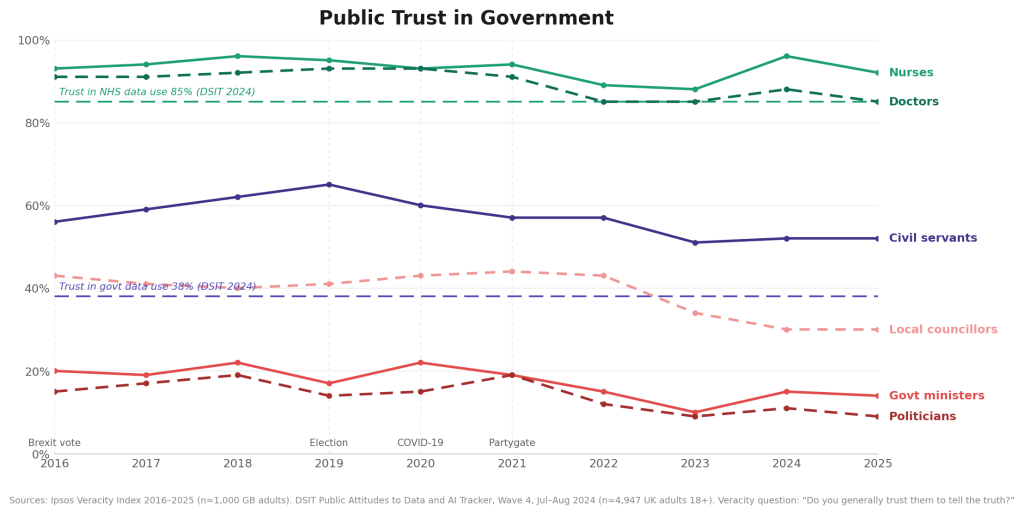
This is where Ipsos’s longstanding Veracity Index provides some useful context. In the graph above, we can see that public trust in Doctors and Nurses has been high for a long time. Despite its faults, we love the NHS. We can also see that public trust in politicians has been consistently low for a decade. This tallies with the British Social Attitudes survey which shows public trust in government decreasing steadily over the last 4 decades, from 40% trusting politicians to put nation over party most of the time in 1986, to only 14% feeling that way today.[2]
The trust ceiling
When you compare these numbers to DSIT’s Public Attitudes to Data and AI Tracker[3], trust in public organisations to act in our best interests with data lands almost exactly where you’d expect it to be, given the Ipsos findings. NHS: 85%. Government: 38%. This, for me, can only be interpreted one way – when you ask the public “do you trust this institution with your data?” the question they are answering is “do you trust this institution?”.
So, here’s the uncomfortable truth for those of us working in government data and AI. The trust environment you are working in isn’t created by anything you will or won’t do with data. You didn’t build the trust ceiling, and you can’t punch through it with a Data Protection Impact Assessment or an Algorithmic Transparency Standard.
Trust absolutely matters. Protection, transparency, ethics, and responsible practice are non-negotiable in the public sector. They set the trust floor — the minimum standard below which you destroy whatever institutional goodwill you started with. But they don’t raise the ceiling.
The mistake I see government teams making is treating the lack of trust as a communications problem, when the primary obstacle is actually something quite different.
The real lever
The path to earning genuine public trust in AI runs through service delivery, not transparency.
When a GP surgery uses AI to reduce waiting times, patients don’t ask what model it used or whether there was a bias audit. They are relieved because it works. When a benefits system uses data intelligently to reduce processing time from six weeks to five days, the person waiting doesn’t want a transparency notice – they just want their payment. Trust follows demonstrated value, consistently delivered over time.
So here’s the key. What makes that possible isn’t a comms strategy. It’s clean, well-governed, tagged, interoperable data with infrastructure that lets good AI actually run in production rather than in a pilot. These are the foundations that make it possible to deliver excellent public services good enough to be trusted.
And government isn’t ready yet. In my recent work assessing AI adoption across UK regulators, the biggest constraint wasn’t public reluctance, it was organisational readiness. Data quality, governance, and capability, not public attitudes, determined whether AI moved beyond pilots. The path to trusted AI in government doesn’t start with messaging – it starts with delivery.
The question isn’t “how do we get the public to trust our AI?”, it’s “are we good enough at data to deserve it?”
[1] UK Public Sector AI Adoption Outlook, Appian, 2026
[3] Addressing trust in public sector data use – GOV.UK